Live Match Analyzer for League of Legends: Win Draft and Mid-Game

The enemy team just locked in their last pick. The timer reads 27 seconds. You're staring at their draft grid doing frantic mental arithmetic — do you have lane priority, who counters this pick, does their comp outscale yours by the 20-minute mark? You start to alt-tab to check the matchup, and the timer keeps bleeding. By the time you find the page, load it, and parse the win-rate columns, you're at 8 seconds and you panic-lock blind. Now you're into a lane you don't understand, guessing at your own win condition.
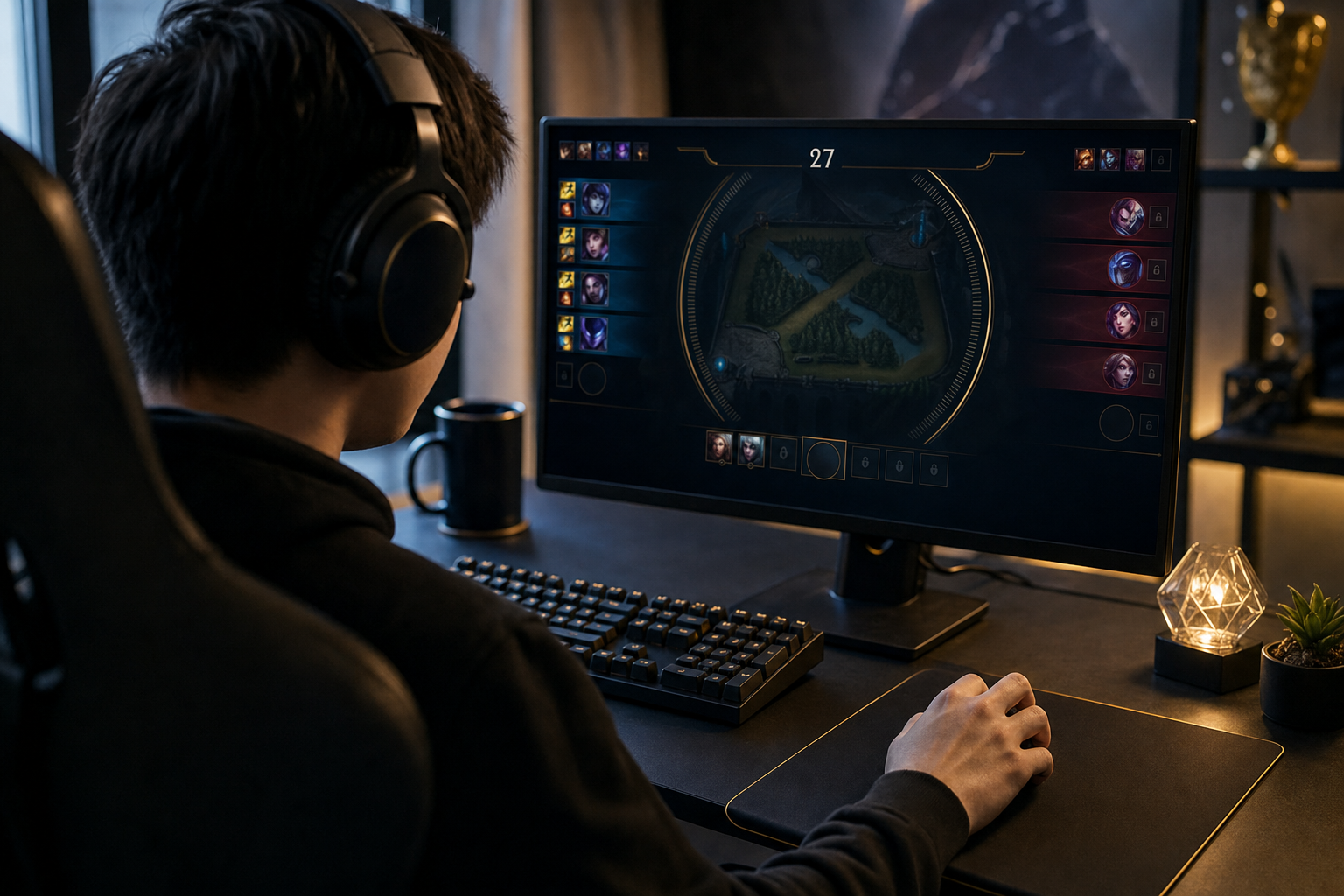
Mid-game gets worse. You're at the 15-minute Baron dance with no clear read on whether your comp wants to fight right now or stall for two more items. You commit on instinct, the fight goes sideways, and the game slips. The gap between players who climb and players who stall isn't always mechanics — often it's the quality of the single decision made inside that 30-second window, and at every mid-game crossroad after it. A live match analyzer league of legends players can pull up during draft turns that panic window into a decision you make with data instead of gut feel.
Table of Contents
- What a Live Match Analyzer Actually Reads From Riot API Data
- Winning the Draft — Counter Picks and Comp Reads Before the Timer Ends
- Reading Power Spikes and Win Conditions Mid-Game
- Live Analysis vs. Manual Research — Where Your Time Actually Goes
- How Different Ranks Should Use a Live Analyzer to Climb
- Is a Live Match Analyzer Allowed? Riot ToS and Safe Use
- Building Live Analysis Into Your Ranked Routine
- Quick Answers Before Your Next Queue
What a Live Match Analyzer Actually Reads From Riot API Data
A live match analyzer league of legends players trust doesn't guess. It pulls specific signals from Riot API data the instant champion select populates, then translates them into reads you can act on. Here is what it reads and why each signal matters.
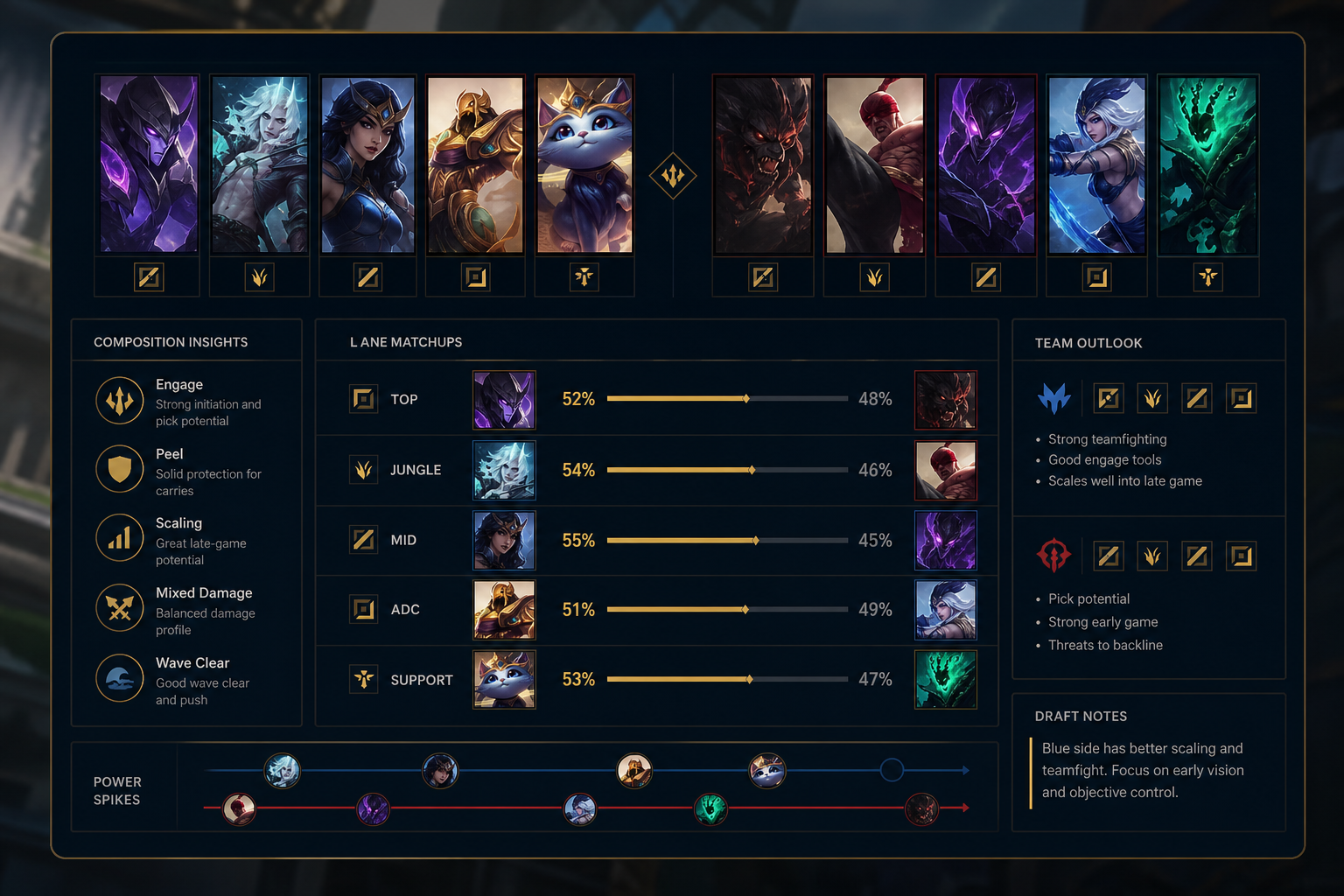
Team composition mapping — The analyzer identifies all 10 locked champions and classifies each by role function: engage, peel, waveclear, or scaling. This matters because comp identity, not individual champion strength, predicts win conditions. A team with three scaling carries and no frontline has a very different game plan than a triple-engage dive comp. Esports analysts build these classifications manually against champion-pool databases — Team Liquid's analyst staff maintains exactly this kind of breakdown for opponent scouting. A live tool compresses that work into a couple of seconds.
Summoner rank and mastery signals — It pulls each player's ranked tier and champion mastery to flag who is sitting on a comfort pick versus who is off-role or on a first-time champion. That off-role support with 4,000 mastery points on a different role is a target. Draft coaches weigh comfort as a core drafting variable, and the EsportsHeaven "Art of the Draft" feature lists it alongside counters and composition as something you evaluate in the pick window.
Matchup win rates on the current patch — It surfaces head-to-head lane win rates filtered to the live patch, not stale season averages. A champion that was oppressive three patches ago may have eaten two nerfs since. Patch-updated matchup data is the difference between a real edge and a coin flip based on old numbers.
Scaling curves — Each champion's relative power by game phase — early, mid, late — so you can immediately see whether your lane wins early or needs to survive to scale. Cross-reference each locked champion's profile in the Champions database and the shape of the game becomes obvious before minions spawn.
Live-lobby data vs. pre-loaded stats — This is the core distinction. Static build sites give you an average across thousands of games — useful, but generic. A live analyzer applies live game data to THIS specific 10-player lobby: these ranks, these mastery flags, this patch, this exact matchup. Real-time match insights beat averages because you're not playing the average game. You're playing this one.
Winning the Draft — Counter Picks and Comp Reads Before the Timer Ends
Drafting well is repeatable. It's not intuition — it's a sequence you run every game, and it maps directly onto the coaching workflow EsportsHeaven describes in its drafting breakdown. Here is the four-step read you run in champion select.
Step 1 — Read the enemy locks. As each champion locks in, identify the enemy comp's win condition. Is it hard engage that wants to force fights? Poke-and-scale that wants to bleed you out? A split-push threat that wants to stretch the map? The analyzer classifies this automatically so you're not building the mental model from scratch under a running clock.
Step 2 — Check your counter options for the open role. Pull the live counter-pick list for the role you're picking into, filtered to current-patch matchup win rates against the specific enemy laner. Not "good champions this patch" — counter picks that beat the exact champion across from you.
Step 3 — Evaluate your team's comp gaps. Identify what your side lacks: engage, peel, or waveclear. A pick that patches the biggest gap beats a marginally higher-win-rate pick that leaves your comp one-dimensional. A 52% champion that gives you the only engage on the team is worth more than a 54% champion that makes you your third scaling carry.
Step 4 — Confirm before the timer ends. Lock the pick that best balances counter matchup, comp need, and your own comfort — using the remaining seconds instead of freezing. A comfort pick you play at 55% beats a "correct" counter you've played four times.

This is where the draft advice audience gets its leverage. Coaches treat draft as a miniature teamfight where informational edges shift win probability before anyone lands a skillshot. The EsportsHeaven feature frames the draft phase as juggling comfort, counters, composition, and scaling at the same time — a load that punishes players who try to hold it all in their head during a 30-second window. Offload the aggregation to the tool and spend your attention on the comp reads that actually require judgment.
Draft is the first teamfight you win — before minions ever spawn.
Reading Power Spikes and Win Conditions Mid-Game
Draft sets the terms. Mid-game decisions cash them in. This is the half of the game where most stuck players hemorrhage LP, because they know their champion is "strong" but not when it's strong, and they fight on instinct instead of on a plan.
Start with power spikes, defined concretely. A power spike is the moment a champion or comp gains a decisive edge, and it lands at three predictable places: key item completions — first mythic or legendary breakpoint where a champion's damage or durability jumps — level thresholds like the level 6 ultimate unlock and the level 11 and 16 ultimate ranks, and simple ultimate availability on cooldown. A fed enemy with ultimate up and a completed first item is a very different threat than the same enemy 40 seconds later with ultimate on cooldown and a recall pending. A live analyzer surfaces WHEN your comp's spike lands relative to the enemy's, so you know which windows are yours.
That relative timing is the whole game, and it's captured by the crossover concept. If your comp is early-game oriented and the enemy scales, your win condition is forcing objectives and fights during your spike window — before the crossover point where their scaling overtakes your tempo. Every minute you let the game go even is a minute you lose. If instead you're the scaling side, your win condition inverts: survive lane, trade time for gold, refuse the fights the enemy wants at 15 minutes, and reach the point where your carries take over. Same map, opposite instructions, and the only way to know which set applies is to read the specific matchup — not a general rule.
That read drives objective priority. Which objective you contest — Void Grubs, dragon, Rift Herald, Baron — depends on the live matchup, not a static checklist. A dive comp spiking at 15 minutes should be forcing Herald and grubs to snowball a lane before the enemy scales. A scaling comp should often cede early objectives and trade for uncontested farm, contesting only what it can take safely. A tool that reads the lobby recommends objectives aligned with your comp's spike timing instead of a one-size template.
There's research behind treating win conditions as a live read rather than a fixed assumption. A peer-reviewed study on deep learning for identifying key performance indicators in League of Legends found that KPIs such as map control and objective pressure strongly correlate with winning, which is exactly the case for surfacing objective and win-condition reads in real time rather than leaning on static tier assumptions. The same body of work builds outcome-prediction models on features like objective control and team gold differences — the quantitative backbone a serious analyzer uses for its live projections.
Academic analysis of how teams actually improve reinforces the point. Graduate research by Joris Roelofs at Eindhoven University of Technology reports that teams enhance performance by systematically analyzing match data and imitating professional strategies — structured analysis outperforms gut feel. The takeaway for solo queue is direct: the players who climb are the ones making objective and fight decisions against a read, not a feeling.
Contrast that with what a static resource can do. A Tier List tells you a champion is strong on the patch — genuinely useful information. But it cannot tell you whether THIS game's comp wants to fight at 15 minutes or wait until 30, because it doesn't know the other nine champions in your lobby. That's the line between generic strength and applied win conditions.
Data doesn't play the game for you — it just stops you from guessing.
Live Analysis vs. Manual Research — Where Your Time Actually Goes
The real cost of research in champion select isn't accuracy — it's attention. You have one 30-second window and a finite amount of focus. Here's how three approaches spend it.
| Approach | Speed in champ select | This-lobby specificity | Mid-game usefulness | Patch freshness |
|---|---|---|---|---|
| Manual tab-checking | Slow (breaks focus) | Low (general lookups) | Minimal (no live prompts) | Depends on manual re-check |
| Static build sites | Moderate (pre-loaded) | Low (averages, not your lobby) | Low (static build only) | Patch-updated but generic |
| Live match analyzer | Fast (auto-populated) | High (reads your 10 players) | High (live spike/objective reads) | Current-patch, lobby-applied |
Manual tab-checking costs the scarcest resource you have in the pick window: attention. Every second spent hunting a page and parsing columns is a second you're not thinking about your comp gaps or your win condition, and the act of alt-tabbing itself breaks the focus you need to make the read. Static build sites solve the speed problem partially — the data is pre-loaded and patch-fresh — but it's lobby-agnostic. It tells you the average outcome across thousands of games, not what happens against the specific enemy laner and the specific enemy comp you're staring at.
A live match analyzer's advantage is not "better numbers." It's the right numbers, applied to this exact game, delivered before the moment passes. That distinction matters more than it sounds. Coaches note that drafting requires juggling comfort, counters, composition, and scaling simultaneously — the EsportsHeaven feature describes exactly this cognitive load — and that load is precisely what a live analyzer offloads. You stop being a data-retrieval system under a clock and start being a decision-maker with the data already in front of you. For a player trying to climb the ranked ladder, that shift in where your attention goes is the entire point.
Be honest about the boundary, though. Live analysis is a champion select and mid-game tool. It does not replace VOD review. Roelofs' research is clear that long-term mechanical and macro improvement comes from self-reflection — watching your own games, finding your own mistakes, and mimicking better play. Live reads and post-game review are complements: one sharpens the decision in the moment, the other builds the pattern recognition that makes future decisions faster. Use both.
The best build in the world is useless if the game's over before you finish reading it.
How Different Ranks Should Use a Live Analyzer to Climb
Not every rank should use the same tool the same way. What helps a Silver player climb is different from what moves the needle for a Diamond player, and the ladder distribution shows exactly why.
Only around 0.34% of players reach Master or higher, according to Esportstales' June 2026 rank distribution. A Silver II player sits around the top 45.3%, Gold IV around the top 29.4%, Diamond IV around the top 2.52%, and Diamond I around the top 0.69%. Industry player-count estimates place a large share of the ranked base between Silver and Platinum — the "learning but serious" band where most competitive players actually live.
| Player Segment | Ladder position | Primary priority | What to ignore for now |
|---|---|---|---|
| New / Casual | Below Gold (top ~30%+) | Learn builds, runes, safe matchups | Deep enemy-tendency reads |
| Mid-ladder Climber | Gold–Platinum band | Counter picks, comp gaps, win conditions | Micro-optimizing marginal matchups |
| High-Elo | Diamond+ (top ~2.5%) | Marginal edges, enemy tendencies, spike timing | Basic build memorization |
New and casual players make up the bulk of the ladder, and their leverage is foundational. Use the analyzer to internalize correct builds and runes and — most valuable — to avoid hard-counter lane matchups before they happen. At this band, games are lost far more often to a losing matchup you didn't recognize or a build you got wrong than to a subtle mid-game misread. Don't chase enemy-tendency analysis yet. Get the fundamentals automatic first, and your win rate climbs on that alone.
Mid-ladder climbers in the Gold–Platinum band — the largest serious cohort on the ladder — get the most leverage from the full toolkit. Games in this range are frequently decided by drafting and mid-game decisions rather than pure mechanics. Two players with similar mechanics will separate based on who drafted the better counter picks, who patched the bigger comp gap, and who read the win conditions correctly at the 15-minute objective. This is the segment where a live analyzer most directly helps you climb the ranked ladder, because it targets exactly the decisions this band gets wrong.
High-elo players at Diamond and above extract marginal edges. Basic build memorization is long since automatic, so the value moves to the fine grain: enemy comfort and off-role flags, precise spike timing, and small matchup swings. Given how thin the top of the ladder is — Diamond I sitting inside the top 0.69% — a 2% matchup edge applied consistently across a climb compounds into real LP. At this level you're not learning the game; you're shaving points off decisions that are already close.
Is a Live Match Analyzer Allowed? Riot ToS and Safe Use
Any tool that touches your game raises a fair question: will it get you banned? For a compliant live match analyzer league of legends players can use with confidence, the answer is no — but the reasons matter, and the line is worth understanding precisely.
Unauthorized third-party programs are prohibited. Riot's Terms of Service prohibit unauthorized programs that interact with Riot's services or provide unfair advantages. The distinction that keeps an analyzer on the right side: a compliant tool uses the official Riot API data and surfaces publicly available information — ranks, matchup stats, comp classifications — that any player could look up. It does not modify the client, inject into the game, or grant hidden information. Reading public data through the sanctioned API is fundamentally different from a program that manipulates the game.
Riot has clamped down on specific real-time features. Riot updated its third-party policy in March 2025 to prohibit enemy ultimate timers, requiring API apps to remove that functionality or lose access, according to community summaries of the official Riot communication. The principle is clear and worth internalizing: tools may inform, but must not reveal information a player couldn't legitimately track themselves. Publicly available matchup and comp data is fine. A live readout of an enemy's exact ultimate cooldown is not.
No intrusive in-client overlays or ads. Riot's Developer Relations team later announced that third-party in-game advertisements are no longer permitted, including ads in overlays, loading screens, and the client itself. The effect is that compliant tools must be purely informational and run alongside the client, not injected into it. An analyzer that presents draft and matchup data out of game clears this bar easily.
The safe-use line, stated plainly. An analyzer that reads draft and matchup data through the official API and presents it out of game is on the correct side. Anything that automates play, overlays into the client, or exposes hidden real-time enemy states is not. That's the whole test. Policies do change, though — Riot has revised its third-party stance more than once in recent years — so confirm the current terms before relying on any tool.
Building Live Analysis Into Your Ranked Routine
Insight only helps if you apply it the same way every game. The pros institutionalize this: Team Liquid's analyst workflow runs a repeatable cycle of data aggregation, opponent scouting, mid-game checks, and post-match review. Here's that cycle compressed into a per-game routine you can run in your next queue.
- Pre-queue setup. Open the LoL Quick live match analyzer for League of Legends before you queue, so it's ready the instant champion select loads — no scramble, no alt-tab. Confirm it's showing the current patch number before you trust a single read.
- Champ-select read (the 30-second workflow). Run the four-step draft read: enemy locks → counter options → comp gaps → confirm. Classify their win condition, pull your counters, patch your biggest gap, and lock with time to spare instead of panic-locking at 3 seconds.
- Note your win condition before minions spawn. Commit to one sentence: "We fight at X" or "We scale to Y." That single line anchors every decision you make for the next 30 minutes. Without it, you're improvising each fight from scratch.
- First-back review. On your first recall, glance at the analyzer's spike and objective read to reconfirm whether your comp wants the next objective or should trade tempo for scaling. Draft plans survive contact with the game about half the time; the first back is your checkpoint.
- Mid-game checkpoint. At each major objective spawn, check whether you're inside your power spikes window before committing to a fight. Fighting outside your window is how even leads evaporate. Contesting inside it is how you turn a coin-flip fight into a favored one.
- Post-game read. After the game, compare the outcome against your pre-game win condition. Did you fight when you should have scaled? Did you cede an objective you should have contested? This is where live reads compound into skill — Roelofs' research points to exactly this kind of structured self-review as the mechanism behind lasting improvement.
Run this loop every game and the decisions that used to freeze you start happening automatically. That's the actual path to climb the ranked ladder — not one brilliant play, but the same disciplined read, game after game, made with data instead of guesswork. Open a live match analyzer for League of Legends before your next queue and start building the habit this game.
Quick Answers Before Your Next Queue
Does a live match analyzer break Riot's Terms of Service? No, provided it uses the official Riot API and surfaces publicly available data — ranks, matchup stats, and comp information — rather than modifying the client or revealing hidden real-time enemy states. Riot's Terms of Service prohibit unauthorized programs and specific features like enemy ultimate timers, but a compliant analyzer that stays informational and runs out of game is on the right side of that line. Because policies do change, confirm the current terms if you're unsure.
How current is the data — does it update every patch? Reputable analyzers refresh matchup and build data each patch, so recommendations reflect the live meta rather than stale season averages. A champion's matchup numbers can swing meaningfully after a single balance change, which is why patch-updated data matters so much. Always confirm the tool displays the current patch number before you trust a read.
Do I need it if I only play one or two champions? Yes. Even one-tricks benefit, because most of the value is in reading the ENEMY comp and the lobby, not your own champion. Knowing which matchups hard-counter your main, and how to adjust your win conditions when you're into one of them, is exactly where a live analyzer helps a limited pool. A narrow champion pool doesn't shrink the value — it sharpens it.
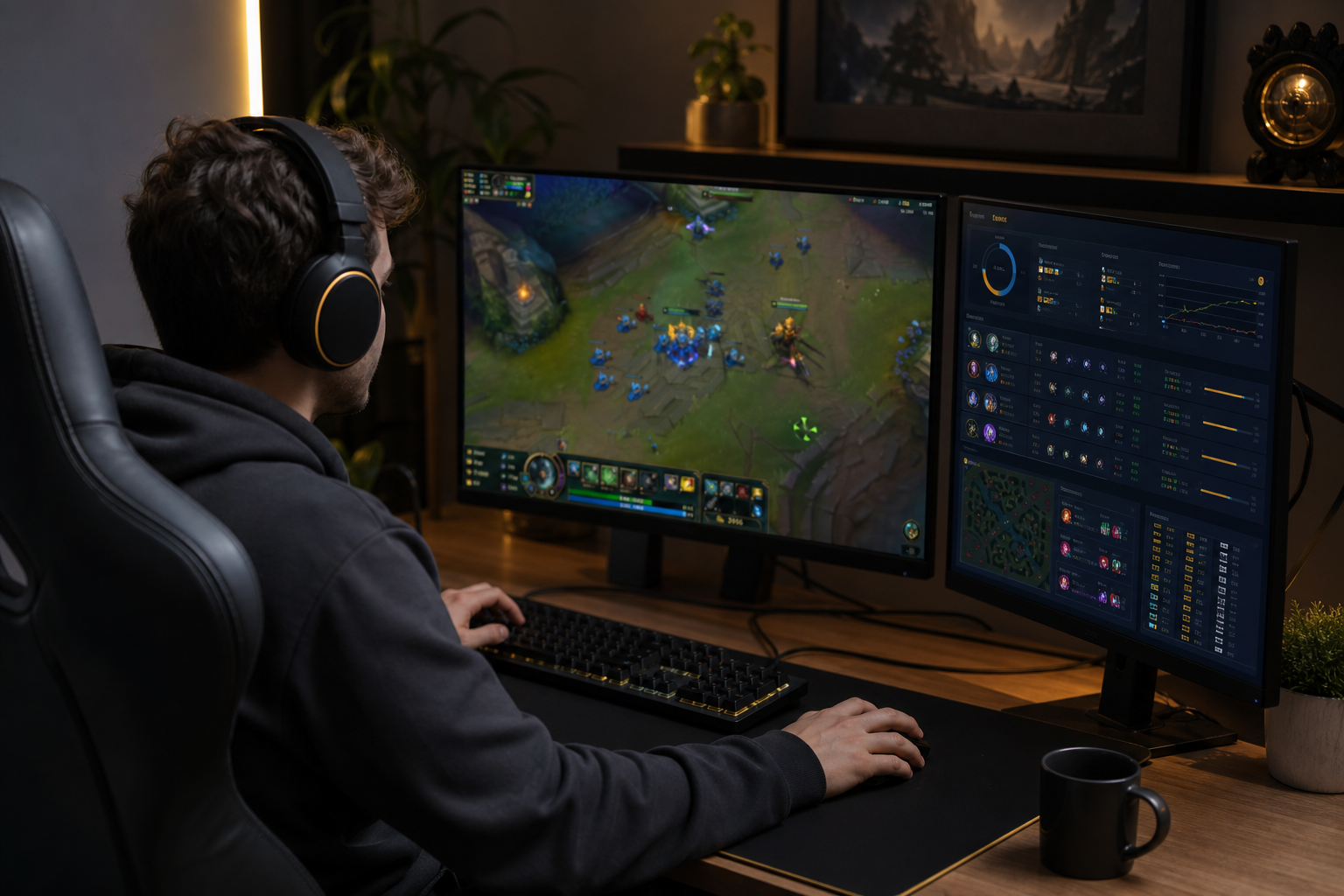
Can it help mid-game, or only during draft? Both. Beyond the draft read, a live analyzer surfaces power spikes and objective priority tied to your specific comp, so your mid-game decisions become data-backed instead of instinctive. The draft sets your plan; the mid-game reads tell you when to execute it.